
Perks
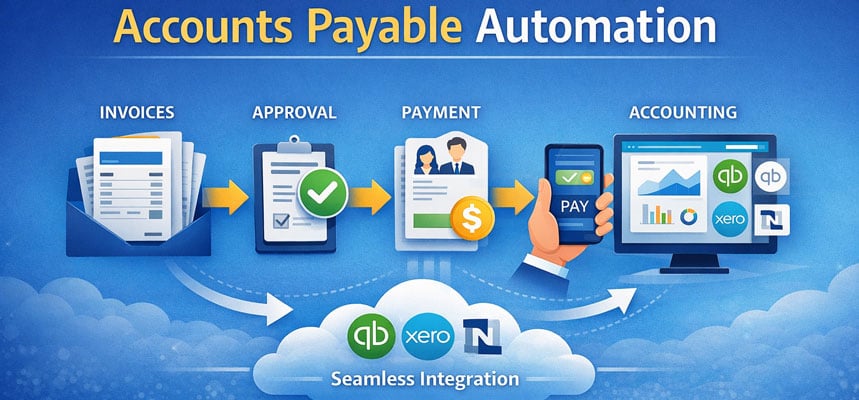

Managing accounts payable (AP) is one of the most important — and often most overlooked — financial processes in a growing company. While many businesses still rely on manual invoice approvals, paper checks, and email chains to manage vendor payments, modern AP automation platforms provide powerful tools that streamline the entire process.
When integrated with accounting systems like QuickBooks, Xero, or NetSuite, these solutions can dramatically improve efficiency, accuracy, and financial visibility.
Below are several reasons why companies are increasingly adopting AP automation.
Traditional accounts payable processes often involve manually entering invoices into accounting systems. This process is time-consuming and introduces the risk of human error.
AP automation platforms automatically:
By reducing manual data entry, companies improve accuracy while freeing up accounting staff to focus on higher-value activities.
Without automation, invoices are often approved through email threads or paper routing. This can cause delays, lost invoices, and confusion about approval status.
Modern AP platforms allow organizations to:
This dramatically reduces approval delays and ensures accountability throughout the process.
One of the most valuable benefits of AP automation is improved cash flow visibility.
Finance leaders can see:
This visibility helps companies make better financial decisions, optimize payment timing, and preserve working capital.
Manual payment processes increase the risk of duplicate payments, unauthorized approvals, or fraud. AP automation systems strengthen internal controls by:
These safeguards help companies protect their financial resources and maintain compliance with internal control policies.
Many growing companies work with vendors across multiple regions and payment methods. Managing these payments manually can be complex.
Platforms usually support:
This reduces administrative burden and ensures vendors are paid quickly and accurately.
Delayed payments and lost invoices can damage vendor relationships. AP automation systems allow companies to:
Stronger vendor relationships often lead to better pricing, improved service, and stronger partnerships.
As companies grow, the volume of invoices increases dramatically. What works for a small organization quickly becomes unsustainable.
AP automation allows businesses to scale without adding significant accounting headcount. With automated workflows and integrated systems, companies can manage far more transactions efficiently.
Accounts payable automation is no longer just a convenience — it is becoming a financial best practice. By implementing platforms and integrating them with modern accounting systems, companies can streamline operations, improve financial visibility, strengthen controls, and support long-term growth.
For finance leaders, investing in AP automation is one of the simplest ways to modernize financial operations and create a more efficient back office.